
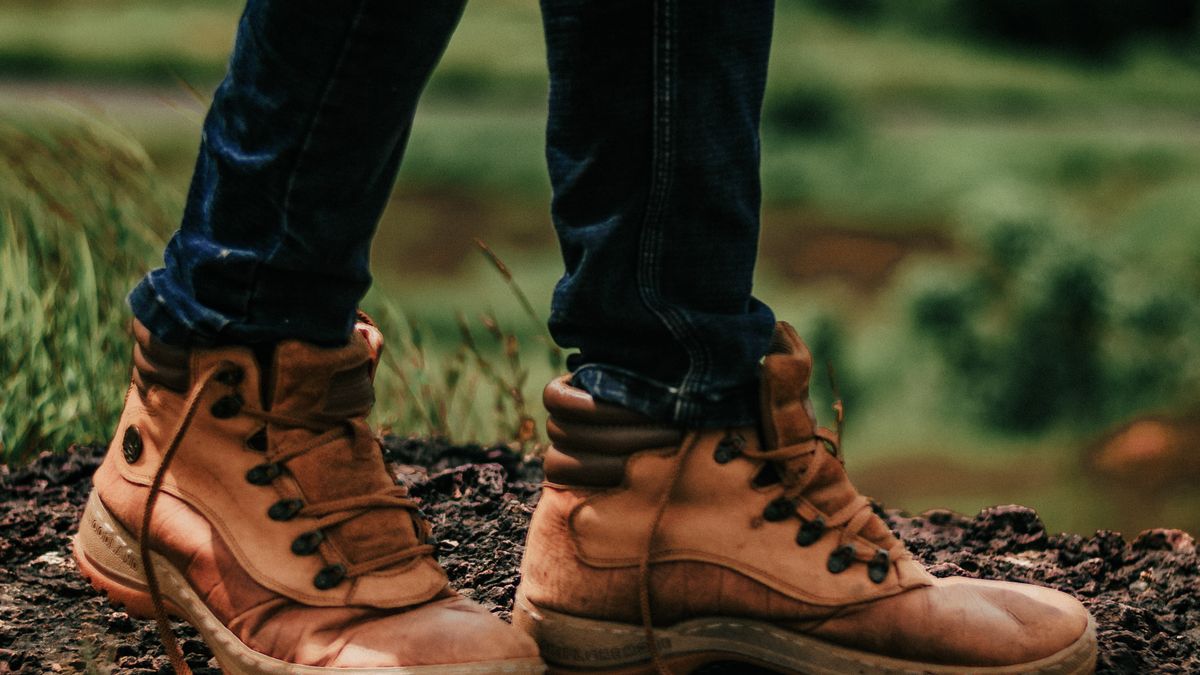
Fell walkers tend to think of grip as a mountain issue, something you worry about on scree and wet rock. But the paths most of us walk every week are far messier. A muddy bridleway in a beech wood, a canal towpath after a fortnight of rain, a footpath across clay-heavy arable land in February — these are the conditions that catch people out, and they ask something different of your footwear.
Clay is the real adversary. It is slick, it sticks, and it fills whatever tread you offer it. Wet roots are worse still, and damp wooden boardwalks and stone stiles can be positively treacherous. So when you choose shoes for this sort of ground, you are balancing three things: how the sole sheds and grips, how quickly the shoe drains and dries, and how much stability you want around the ankle. Get those three in proportion and you will stop dreading the winter months.
Lug depth is the first number worth knowing. For lowland mud, something in the region of 4–6mm is the sweet spot. Shallower than that and you skate on greasy surfaces; much deeper and you feel the lugs through the sole on hard towpath and road sections, which is tiring over a long day.
Spacing matters as much as depth. Mud clogs, and a sole that clogs is a sole with no tread at all. Look for lugs with clear gaps between them so the mud can be squeezed out as you roll through your stride. Tightly packed, shallow chevrons are a liability in clay.
If your routes mix a mile of tarmac lane with three miles of boggy field, accept a compromise: a mid-depth, sticky-rubber sole with moderate spacing. It will not be perfect anywhere, but it will be safe everywhere.
Here is the counter-intuitive bit. For wet lowland walking, a fully waterproof shoe is often the wrong answer. Water gets in over the top at every ford and puddle, and once it is in, a membrane-lined shoe holds it there. You end up walking in a small bath.
Instead, look for a shoe that lets water out as fast as it lets it in. That means mesh panels, a gusseted tongue, and drainage holes or a permeable footbed. A shoe like this will be soaked within twenty minutes and substantially drier an hour later — which is worth far more than a dry first hour followed by a soggy afternoon.
Wool or synthetic socks help enormously here. Cotton does not: it holds water against the skin and is the fastest route to blisters. Carry a spare pair in your rucksack, and change at the halfway point if the day is wet. Your feet will thank you.
Ankle support is not simply about the height of the collar. On muddy lowland paths, a low-cut shoe gives you freedom and lightness, and for towpaths, woodland tracks and reasonably level field paths that is plenty. A low shoe also dries faster and weighs less over a long day.
Mid-cut shoes become worthwhile if you are carrying a heavier pack, walking on rutted farm tracks, or crossing tussocky, uneven ground where you regularly roll over on hidden stones. The collar adds a little protection and a little reassurance under load, but it will not save you from a bad fall — good foot placement and a well-laced, secure fit do far more work.
Whatever you choose, the fit is the real support. Your heel should be locked in place, your toes should not touch the front on descents, and you want roughly a thumb's width of space ahead of your longest toe.
Get the grip, drainage and fit right for your own regular routes, and the muddy months stop being an obstacle. They become the best walking of the year.

Hi, my name is Anthony kuber. I am artist and fashion designer.
I love to travel and writing blogging.
Your email address will not be published. Required fields are marked *
Software Developer & Writer
Hey, I'm Diva, a developer and writer blending code and creativity. I'm driven by a deep curiosity and a relentless pursuit of excellence. Join me as I craft digital solutions and captivating stories.


